Recommendations What is self insured retention You Must Read
Home » Motor Insurance » Recommendations What is self insured retention You Must ReadYour What is self insured retention property are available in this site. What is self insured retention are a policy that is most popular and liked by everyone today. You can Get the What is self insured retention files here. Get all free family.
If you’re looking for what is self insured retention images information related to the what is self insured retention topic, you have visit the right blog. Our website frequently provides you with suggestions for refferencing the highest quality video and picture content, please kindly search and locate more enlightening video articles and graphics that match your interests.
What Is Self Insured Retention. As premiums increase in the commercial habitational sector, an increasing number of organizations seek alternatives to reduce insurance costs. That means that the insured who wishes to purchase a commercial umbrella needs to have either an underlying liability policy, such as a commercial general liability, a business auto liability or an employers� liability policy, or carry a sir of a certain amount. As we all know, claims below the chosen level of retention are “retained” (paid for) by the entity, not the excess insurer. Example john slips and falls on a substance on the floor of a publix.
 Reminder Modify Awards if Liability Deductible/Self From home.arbfile.org
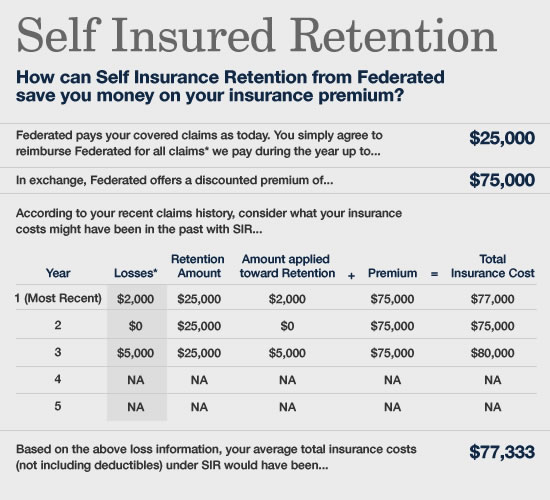
A sir is normally a specific amount your company must pay for a claim before the business umbrella insurance will pay on the claim. It is the amount of money that the policyholder (the person or company who purchased the policy of insurance) must pay to defend or resolve a claim for damages before the insurer steps in and provides coverage under the policy. Both sir and deductibles are used to keep premiums down. A ‘self insured retention’ usually refers to a specific sum or a percentage of loss that is the insured’s responsibility and is not covered under the policy. If a claim is presented that needs to get funded your company pays the claim (up to the retention limit) ; That means that the insured who wishes to purchase a commercial umbrella needs to have either an underlying liability policy, such as a commercial general liability, a business auto liability or an employers� liability policy, or carry a sir of a certain amount.
Thus, under a policy written with a sir provision, the insured (rather than the insurer) would pay defense and/or indemnity costs associated with a claim until the.
This brief article is for the latter two categories. This brief article is for the latter two categories. For example, a policy with a $1,000,000 limit and a $100,000 deductible. Both sir and deductibles are used to keep premiums down. Self insured retention (sir) is similar to primary insurance. The answer to the question what’s the difference between a deductible and a self insured retention is that deductibles reduce the amount of insurance available whereas a self insured retention is applied and the limit of insurance is fully available above that amount.
 Source: acronymsandslang.com
Both sir and deductibles are used to keep premiums down. A brief video explaining what a self insured retention is, particularly regarding your general liability policy and how it differs from a deductible.in reg. This brief article is for the latter two categories. If implemented correctly, it will encourage them to participate in what is a mutually beneficial relationship. A ‘self insured retention’ usually refers to a specific sum or a percentage of loss that is the insured’s responsibility and is not covered under the policy.
 Source: youtube.com
An organisation and an insurer both have an interest that it is set in an appropriate amount so that coverage can function as intended. A brief video explaining what a self insured retention is, particularly regarding your general liability policy and how it differs from a deductible.in reg. And some of you didn�t know there was a difference between sirs and deductibles. This brief article is for the latter two categories. A sir is normally a specific amount your company must pay for a claim before the business umbrella insurance will pay on the claim.
 Source: hisnv.com
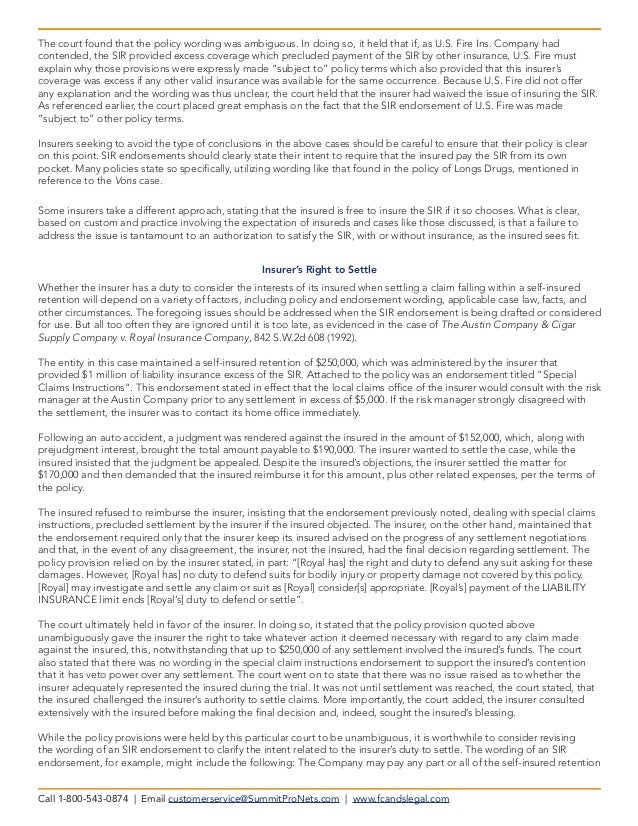
Thus, under a policy written with a sir provision, the insured (rather than the insurer) would pay defense and/or indemnity costs associated with a claim until the. This brief article is for the latter two categories. A sir is normally a specific amount your company must pay for a claim before the business umbrella insurance will pay on the claim. An sir is “a dollar amount specified in a liability insurance policy that must be paid by the insured before the insurance policy will respond to a loss.”1 thus, under a liability policy that is subject to an sir, “the insured (rather than the insurer) would pay defense and/or indemnity costs associated. And some of you didn�t know there was a difference between sirs and deductibles.
 Source: slideshare.net
For example, a policy with a $1,000,000 limit and a $100,000 deductible. A sir is normally a specific amount your company must pay for a claim before the business umbrella insurance will pay on the claim. Then the insurance carrier comes in &. The answer to the question what’s the difference between a deductible and a self insured retention is that deductibles reduce the amount of insurance available whereas a self insured retention is applied and the limit of insurance is fully available above that amount. It is the amount of money that the policyholder (the person or company who purchased the policy of insurance) must pay to defend or resolve a claim for damages before the insurer steps in and provides coverage under the policy.
 Source: thebalancesmb.com
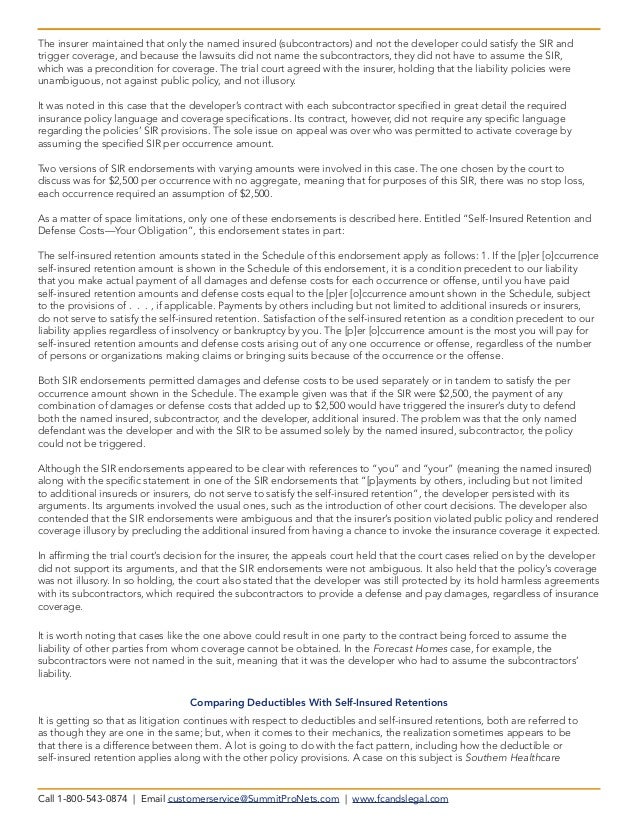
The retention usually refers to a portion of the loss the insured itself must pay that is not insured under any other insurance policy Thus, under a policy written with a self insured retention provision, the insured (rather than the insurer) would pay defense and/or indemnity costs associated with a claim until. The retention usually refers to a portion of the loss the insured itself must pay that is not insured under any other insurance policy This brief article is for the latter two categories. It is the amount of money that the policyholder (the person or company who purchased the policy of insurance) must pay to defend or resolve a claim for damages before the insurer steps in and provides coverage under the policy.
 Source: slideshare.net
Self insured retention (sir) is similar to primary insurance. This brief article is for the latter two categories. The retention usually refers to a portion of the loss the insured itself must pay that is not insured under any other insurance policy A brief video explaining what a self insured retention is, particularly regarding your general liability policy and how it differs from a deductible.in reg. If a claim is presented that needs to get funded your company pays the claim (up to the retention limit) ;
Source: home.arbfile.org
Thus, under a policy written with a self insured retention provision, the insured (rather than the insurer) would pay defense and/or indemnity costs associated with a claim until. The retention usually refers to a portion of the loss the insured itself must pay that is not insured under any other insurance policy Thus, under a policy written with a sir provision, the insured (rather than the insurer) would pay defense and/or indemnity costs associated with a claim until the. For example, a policy with a $1,000,000 limit and a $100,000 deductible. As we all know, claims below the chosen level of retention are “retained” (paid for) by the entity, not the excess insurer.
 Source: slideshare.net
Self insured retention is seen in commercial general. While some view these terms as essentially being interchangeable due to their overall concept being similar, there are some key differences businesses should be aware of. Self insured retention is seen in commercial general. Then the insurance carrier comes in &. As we all know, claims below the chosen level of retention are “retained” (paid for) by the entity, not the excess insurer.
 Source: thinkccig.com
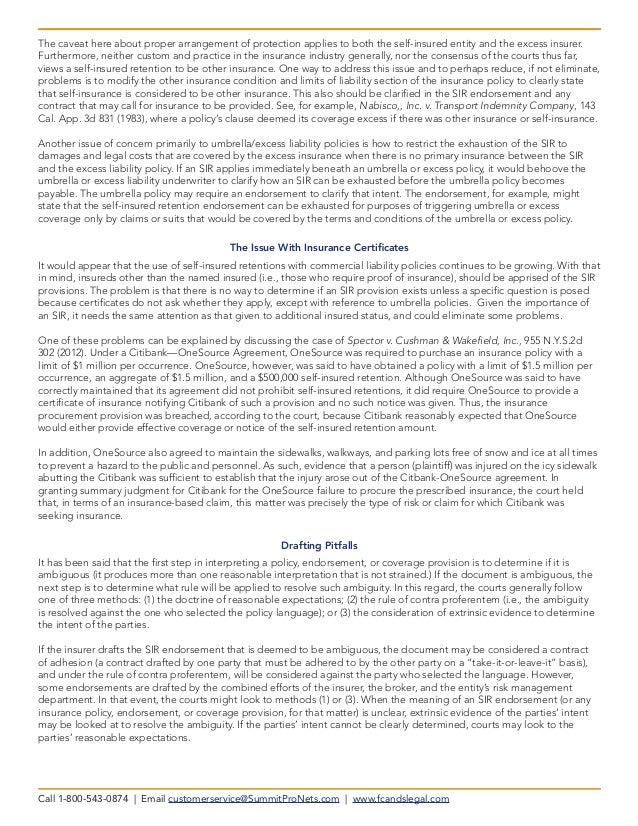
That means that the insured who wishes to purchase a commercial umbrella needs to have either an underlying liability policy, such as a commercial general liability, a business auto liability or an employers� liability policy, or carry a sir of a certain amount. As premiums increase in the commercial habitational sector, an increasing number of organizations seek alternatives to reduce insurance costs. Thus, under a policy written with a self insured retention provision, the insured (rather than the insurer) would pay defense and/or indemnity costs associated with a claim until. Then the insurance carrier comes in &. If a claim is presented that needs to get funded your company pays the claim (up to the retention limit) ;
 Source: myidea.eu.org
An organisation and an insurer both have an interest that it is set in an appropriate amount so that coverage can function as intended. A ‘self insured retention’ usually refers to a specific sum or a percentage of loss that is the insured’s responsibility and is not covered under the policy. A brief video explaining what a self insured retention is, particularly regarding your general liability policy and how it differs from a deductible.in reg. And some of you didn�t know there was a difference between sirs and deductibles. Both sir and deductibles are used to keep premiums down.
 Source: domvverhdnom.com
Example john slips and falls on a substance on the floor of a publix. Self insured retention is seen in commercial general. It is the amount of money that the policyholder (the person or company who purchased the policy of insurance) must pay to defend or resolve a claim for damages before the insurer steps in and provides coverage under the policy. The retention usually refers to a portion of the loss the insured itself must pay that is not insured under any other insurance policy An sir is “a dollar amount specified in a liability insurance policy that must be paid by the insured before the insurance policy will respond to a loss.”1 thus, under a liability policy that is subject to an sir, “the insured (rather than the insurer) would pay defense and/or indemnity costs associated.
 Source: youtube.com
An sir is “a dollar amount specified in a liability insurance policy that must be paid by the insured before the insurance policy will respond to a loss.”1 thus, under a liability policy that is subject to an sir, “the insured (rather than the insurer) would pay defense and/or indemnity costs associated. This brief article is for the latter two categories. Thus, under a policy written with a sir provision, the insured (rather than the insurer) would pay defense and/or indemnity costs associated with a claim until the. Both sir and deductibles are used to keep premiums down. Example john slips and falls on a substance on the floor of a publix.
 Source: transadj.com
Example john slips and falls on a substance on the floor of a publix. As we all know, claims below the chosen level of retention are “retained” (paid for) by the entity, not the excess insurer. An sir is “a dollar amount specified in a liability insurance policy that must be paid by the insured before the insurance policy will respond to a loss.”1 thus, under a liability policy that is subject to an sir, “the insured (rather than the insurer) would pay defense and/or indemnity costs associated. If a claim is presented that needs to get funded your company pays the claim (up to the retention limit) ; The sir can be one tactic.
 Source: youtube.com
Thus, under a policy written with a self insured retention provision, the insured (rather than the insurer) would pay defense and/or indemnity costs associated with a claim until. For example, a policy with a $1,000,000 limit and a $100,000 deductible. That means that the insured who wishes to purchase a commercial umbrella needs to have either an underlying liability policy, such as a commercial general liability, a business auto liability or an employers� liability policy, or carry a sir of a certain amount. The sir can be one tactic. This brief article is for the latter two categories.
 Source: reshield.com
Then the insurance carrier comes in &. Self insured retention (sir) is similar to primary insurance. This brief article is for the latter two categories. That means that the insured who wishes to purchase a commercial umbrella needs to have either an underlying liability policy, such as a commercial general liability, a business auto liability or an employers� liability policy, or carry a sir of a certain amount. Self insured retention is seen in commercial general.
 Source: youtube.com
Self insured retention (sir) is similar to primary insurance. An organisation and an insurer both have an interest that it is set in an appropriate amount so that coverage can function as intended. For example, a policy with a $1,000,000 limit and a $100,000 deductible. Self insured retention (sir) is similar to primary insurance. Then the insurance carrier comes in &.
 Source: libertymutualcanada.com
A ‘self insured retention’ usually refers to a specific sum or a percentage of loss that is the insured’s responsibility and is not covered under the policy. If implemented correctly, it will encourage them to participate in what is a mutually beneficial relationship. While some view these terms as essentially being interchangeable due to their overall concept being similar, there are some key differences businesses should be aware of. And some of you didn�t know there was a difference between sirs and deductibles. An sir is “a dollar amount specified in a liability insurance policy that must be paid by the insured before the insurance policy will respond to a loss.”1 thus, under a liability policy that is subject to an sir, “the insured (rather than the insurer) would pay defense and/or indemnity costs associated.
 Source: lifechangingsystem1.blogspot.com
If implemented correctly, it will encourage them to participate in what is a mutually beneficial relationship. The sir can be one tactic. Both sir and deductibles are used to keep premiums down. Thus, under a policy written with a sir provision, the insured (rather than the insurer) would pay defense and/or indemnity costs associated with a claim until the. Then the insurance carrier comes in &.
This site is an open community for users to share their favorite wallpapers on the internet, all images or pictures in this website are for personal wallpaper use only, it is stricly prohibited to use this wallpaper for commercial purposes, if you are the author and find this image is shared without your permission, please kindly raise a DMCA report to Us.
If you find this site helpful, please support us by sharing this posts to your own social media accounts like Facebook, Instagram and so on or you can also bookmark this blog page with the title what is self insured retention by using Ctrl + D for devices a laptop with a Windows operating system or Command + D for laptops with an Apple operating system. If you use a smartphone, you can also use the drawer menu of the browser you are using. Whether it’s a Windows, Mac, iOS or Android operating system, you will still be able to bookmark this website.
